
8 min read · 1,965 words

The fastest way to be displaced by AI is to stay at the level AI operates at most comfortably.
Monday we established that AI cannot do architecture: the training data problem is structural, not temporary, and the gap between generating plausible-looking code and designing systems that survive contact with the real world is not closing. Wednesday we looked at what that means for architects: the role shifts from implementation to constraint-setting, and the value moves from producing code to creating the conditions under which good code can be produced.
That leaves an obvious question. What happens to developers?
The anxiety here is legitimate in a way it was not quite for architects. Architects were never primarily coders. Developers were. If AI writes code, and code was what you did all day, the concern is not irrational.
But it is misdirected. Because what most developers actually do (the part that matters) is not typing. It is understanding. And that part does not go away.
The Anxiety Is Legitimate, for Some Developers
There is a real category of developer work that AI displaces directly: translating a well-specified requirement into boilerplate code. CRUD endpoints, schema migrations, test fixtures, configuration glue, adapter wrappers. Work where the problem is fully understood and the solution is a predictable application of known patterns.
If that description covers most of your day, your concern is founded. AI is already fast and accurate at exactly that kind of work, and it is getting faster.
But if your day involves understanding why a requirement is stated the way it is, recognizing that the stated requirement is not actually the right solution to the underlying problem, knowing which parts of the existing system will resist the change and why, deciding where the new code belongs in the structure. None of that is going away. That is the job. It always was. The boilerplate was just what you had to do to express it.
The developer’s job was never primarily to type code. It was to understand the problem well enough to express it correctly. AI changes what “expressing it” looks like. It does not change what “understanding it” requires.
From Author to Owner

The shift for developers is from author to owner. You are not going to write every line. You are going to be the engineer of record for every line: a different and in some ways harder responsibility.
Authorship requires fluency. Ownership requires judgment. You can be a fluent author of code without fully understanding why the structure you chose will or will not hold. Ownership does not allow that gap. When something breaks, you own it. When a structural decision turns out to have been wrong, you own that too. The AI that generated the code is not on the hook.
This reframes what the job requires:
- Reading critically, not just writing. The bottleneck moves from producing code to evaluating it. Does this do what I intended? Does it do it the right way? What did it assume that I did not state?
- Directing precisely. Vague prompts produce vague solutions. Producing good AI output is a communication skill: stating context, constraints, component role, expected interface, and success criteria clearly enough that the result is evaluable.
- Integrating carefully. AI output is local. It does not know what is next to it in the system. The developer connects the pieces, identifies the conflicts, and makes the seams correct.
- Debugging deeply. When production breaks, the debugging path is yours. AI did not generate your understanding of the system. You either have it or you do not.
The Decisions That Remain Yours
Three categories of decision are not delegable to AI in the developer seat, the same way three categories are not delegable in the architect seat. They are different decisions, but the shape of the problem is the same.
Domain reasoning. AI does not know your business. It does not know that the customer entity in this context means an active subscriber, not an account holder, and that the distinction matters for every pricing calculation downstream. It does not know that the edge case your PM flagged in a Slack thread last week is actually the common case in one specific geographic market. You do. That knowledge has to drive the specification before AI writes anything.
Structural judgment at the component level. The architect defines the system’s boundaries. The developer is responsible for respecting them in implementation. When AI generates a solution that works but violates a component’s role (an Engine reaching into infrastructure directly, a Manager containing business logic, a Utility with a side effect), that violation is yours to catch. This requires knowing what the structural rules are and why they exist.
Test design. You know what needs to be proven. AI does not. The test suite is not just coverage; it is a specification of what the system is supposed to do and evidence that it does it. Writing tests that actually prove the right things, at the right level, with the right scope, is a judgment call that reflects your understanding of the domain and the structure. AI can implement tests from a specification. It cannot write the specification.
Structural Literacy Is the Multiplier
The highest-leverage thing a developer can do right now is develop structural literacy: the ability to look at code and understand not just what it does, but where it belongs, what it is coupling to, and whether the structure it creates will absorb future change or resist it.
This is what separates the developer who can verify AI output from the developer who can only execute it. The first can look at an AI-generated solution and say: this works, but it put business logic in the Accessor, which means the next time this rule changes we will touch infrastructure. The second can only run the tests and see if they pass.
| Structural Pattern | What It Signals When AI Gets It Wrong | The Fix |
|---|---|---|
| Business logic in an Accessor | Engine did not receive a clear role boundary in the prompt | Extract to Engine; Accessor maps only |
| Manager containing calculation | Orchestration and execution were not distinguished in the specification | Move to Engine; Manager routes only |
| Implicit shared state between components | Component roles and interfaces were not specified; AI defaulted to convenience | Make the interface explicit; enforce at the boundary |
| Test requiring multiple mocks for a single component | Component absorbed responsibilities across tiers | Decompose; one mock per role boundary |
None of these patterns are obvious from looking at whether the tests pass. They require understanding the structural model well enough to recognize when generated code is plausible but wrong.
Testing as Verification, Not Just Coverage
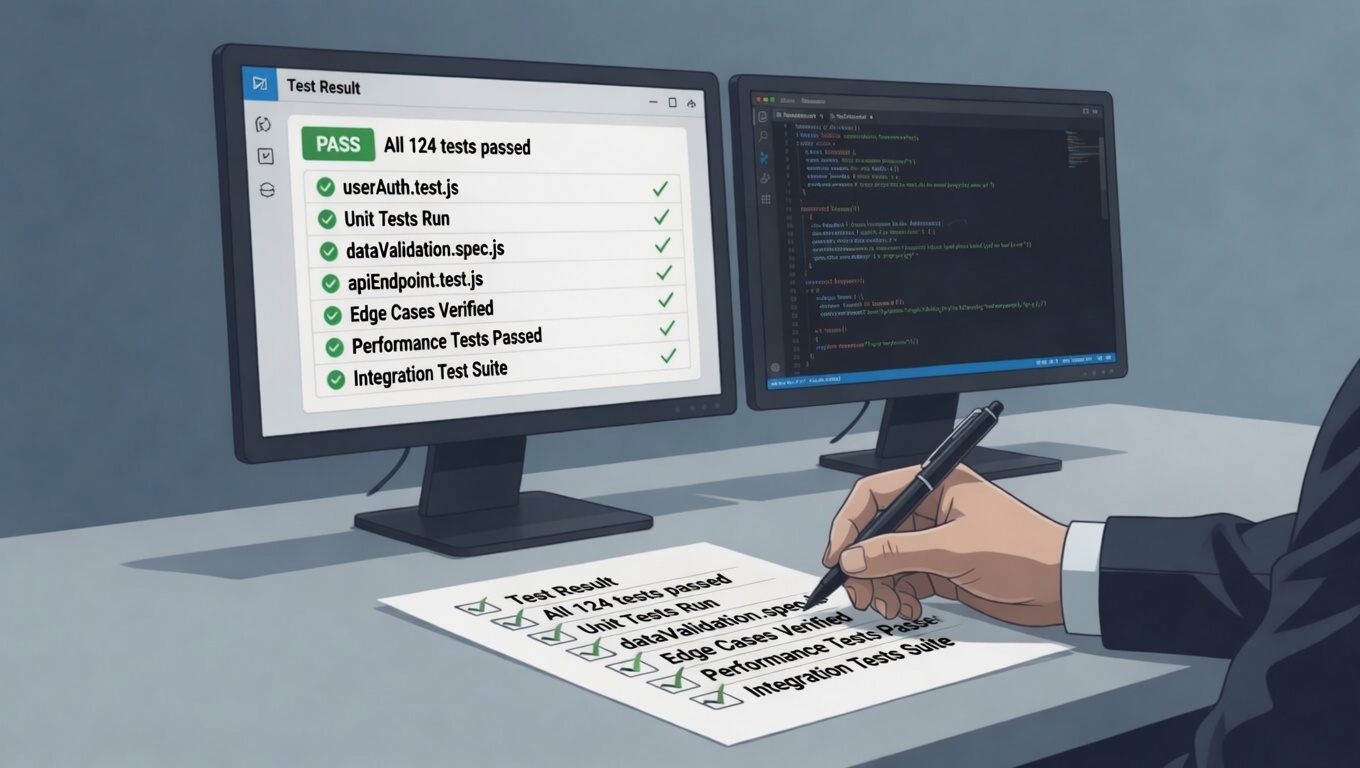
In an AI-augmented workflow, testing changes character. It becomes the primary verification mechanism for someone else’s output, not just the safety net for your own.
The most effective pattern: write the test first. Not in the traditional TDD sense of using the test to design the interface, but in the sense of specifying what needs to be proven before asking AI to prove it. Define the component’s role, its inputs, its outputs, the states it needs to handle, and the states it must not produce. Then let AI implement against that specification. Then verify.
This matters because AI output is optimistic. It handles the cases you described. It tends not to handle the cases you did not describe but should have. The test suite you write before prompting is the artifact that forces you to think through the complete specification. It is also the artifact that catches the gap between what you asked for and what was generated.
The test is not a check on whether the AI succeeded. It is the specification from which the AI worked. If the test is weak, the implementation will be locally correct and structurally wrong.
Applied to Boundary-Driven Testing: the same structural rules that determine test profiles by component role now apply to verification of AI output. An Engine should be testable in isolation with a single mock at the Accessor boundary. If the AI-generated Engine requires more mocks than that, the boundary is wrong. If the Manager-level integration test requires more setup than the contract states the Engines can emit, the Manager is making decisions it should not be making. The test structure is still an architectural map. The fact that the code was generated does not change what the map should look like.
What Changes Day to Day
The practical shift is not dramatic. It is a reallocation of where deliberate effort goes.
Before AI: most time went into writing code. Some time went into understanding the problem, some into testing, some into review.
After: the understanding and specification work expands because it has to happen before prompting. The testing work expands because verification is now the primary quality mechanism. The writing shrinks significantly. Review does not shrink; it changes character, requiring structural evaluation rather than line-by-line authorship.
The Specification Feedback Loop. Developers who adopt AI-assisted workflows quickly discover that the clarity of their output correlates directly with the quality of their specification, not with the capability of the model. Vague prompts produce working code that misses the point. Precise prompts (including component role, structural constraints, interface contract, and test cases) produce output that requires minimal structural correction.
This creates an unexpected benefit: the discipline of writing good prompts forces the same kind of upfront thinking that experienced developers do naturally, and junior developers often skip. The prompt becomes the specification. The specification reveals the gaps. The gaps are cheaper to find before implementation than after.
The Reading Gap. Developers who learned primarily by writing code have a well-developed intuition for generating solutions but an underdeveloped intuition for evaluating them. This gap becomes apparent immediately in AI-assisted workflows: they produce a lot of output, but they accept too much of it uncritically.
The fix is deliberate: make code review a structured practice with explicit structural criteria, not just a pass-over for obvious errors. Review AI-generated code against the same structural questions you would apply to any code: does this component respect its role? Is it mockable in isolation? Does it couple to things it should not? The criteria are the same. The volume is higher.
Domain Depth as Durable Advantage. The developers who are most effective in AI-augmented workflows are consistently the ones with the deepest domain knowledge, not the ones with the broadest technical toolkit. Domain depth is what lets you specify precisely. It is what lets you recognize when AI output is locally correct but domain-wrong. It is what lets you catch the edge case the requirement did not mention because the person writing the requirement did not know it existed.
Domain depth takes years to build and is impossible for AI to replicate from a prompt. It is the most durable advantage a developer can have.
The developers who are not getting squeezed are not the ones who are faster at generating code. They are the ones who moved up: to understanding, to specification, to structural judgment, to owning the outcome.
AI handles the typing. The understanding was always the job. In teams where developers knew that, not much changes. In teams where developers confused the typing for the job, the disruption is real, and it was already coming before AI arrived.
Not a metaphor. A literal shift in where skilled work lives. The code is cheap now. The judgment that makes it correct is not.